WooCommerce Discount Scheduling Plugin: Smart Cycle Discounts Guide

Smart Cycle Discounts · Product Guide
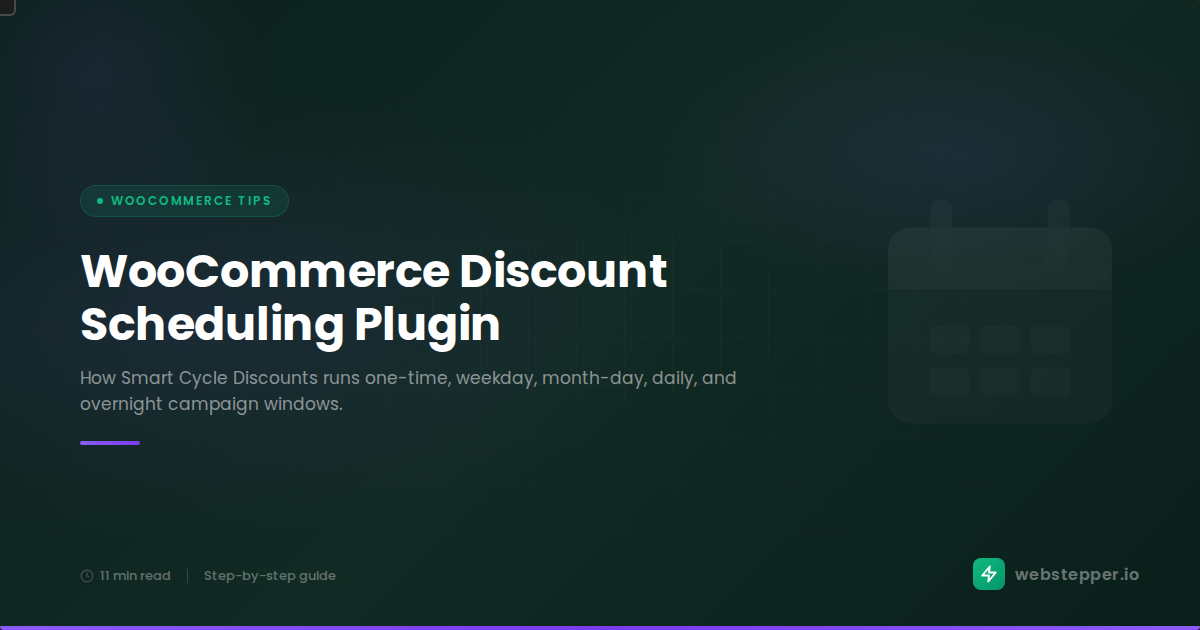
Schedule WooCommerce Discounts as Complete Campaigns
Set exact one-time dates or reusable weekday, month-day, daily, and overnight windows—with store-timezone previews and automatic runtime activation.
Direct answer
Smart Cycle Discounts is a WooCommerce discount scheduling plugin for one-time and recurring campaigns. Scheduling is included free. You can select exact start and end dates or repeat a promotion on chosen weekdays, chosen days of the month—including the last day—or every day inside a time window. Overnight windows are supported, and the preview shows upcoming occurrences in the campaign timezone.
Disclosure: Webstepper develops Smart Cycle Discounts. This guide is checked against the current recurrence implementation; it also explains timezone, WP-Cron, cache, and storefront-query limits that scheduling alone cannot remove.
Every Friday, you log into your WooCommerce store. You change 15 product prices for the weekend sale. Sunday night, you change them all back. Next Friday, you do it again.
This works for a while. Then you forget one Friday. Or you set the wrong price. Or you go on vacation and the weekend sale doesn’t happen. Your regular customers notice.
Recurring sales should run themselves. You configure them once — the products, the discount, the schedule — and they repeat automatically. Every week. Every month. Every season. No manual work, no missed promotions, no Sunday night price resets.
This guide shows you exactly how to set that up in WooCommerce.
Why recurring sales outperform one-time promotions
One-time sales create an event. Recurring sales create an expectation. Whether that expectation is valuable depends on margin, customer behavior, and whether buyers begin delaying full-price purchases, so recurring schedules should be measured rather than assumed to outperform.
Customers develop habits
When you run a “Weekend Special” every Friday through Sunday, regular customers learn the rhythm. They start planning purchases around your schedule. “I’ll wait until Friday” becomes a buying habit — and habits drive repeat revenue more reliably than any single flash sale.
You build anticipation without effort
A one-time sale requires promotion: emails, social posts, banners. A recurring sale promotes itself through consistency. After 3-4 cycles, your customers know it’s coming. You can still promote it, but the sale works even without marketing push.
You stop reinventing the wheel
Every time you manually set up a sale, you spend time on logistics: picking products, setting prices, scheduling dates. With recurring campaigns, that work happens once. After that, the campaign runs on autopilot while you focus on inventory, marketing, and growth.
The operational failure to avoid
A recurring offer that depends on a person logging in at both boundaries has two failure points every cycle: starting late and ending late. Automation removes the repetitive edit, but the store still needs reliable scheduled-task execution, correct timezone settings, and post-launch monitoring.
5 types of recurring sales that work
Not every product or store needs the same recurring schedule. Here are the patterns that drive results:
1. Weekend specials (weekly)
Runs every Friday through Sunday. The most common recurring promotion. Works for almost any store because shopping peaks on weekends anyway. You’re adding a discount to a behavior that’s already happening.
Best for: Fashion, home goods, gifts, food and drink, anything people browse on weekends.
2. Mid-week deal (weekly)
Runs every Tuesday or Wednesday. Targets the mid-week traffic dip. A “Hump Day Deal” or “Tuesday Special” gives customers a reason to visit on slow days, smoothing your revenue across the week.
Best for: Stores with strong weekend traffic that want to balance the week.
3. Happy hour (daily)
Runs every day from 5 PM to 9 PM (or any time window). Creates daily urgency with a predictable discount window. Customers learn to check your store at specific times.
Best for: Digital products, food delivery, subscription boxes, stores with international audiences across time zones.
4. Monthly event (monthly)
Runs on selected calendar days such as the 1st of every month. A monthly sale can feel like an event. “Monthly Opening Deal” or “Month-End Clearance” creates a consistent promotional anchor without implying support for an nth-weekday rule.
Best for: Stores that don’t want to discount weekly but need regular promotional momentum.
5. Seasonal one-time campaigns
Schedule each seasonal window in advance. Spring launches, summer clearance, back-to-school, and holiday campaigns rarely share the same calendar dates or inventory every year. Smart Cycle Discounts supports exact future start and end dates; review and duplicate the strategy next season rather than pretending a yearly rule can run safely without merchandising review.
Best for: Fashion, outdoor gear, seasonal products, gift shops.
The WooCommerce problem: no native recurring
WooCommerce does not support recurring sales. The built-in sale price scheduler lets you set a single start date and end date per product. There’s no option for “repeat every week” or “run on the first of each month.”
Your options without a plugin:
- Manual repetition — log in every cycle, change prices, change them back. Reliable until you forget.
- WP-Cron with custom code — write PHP that triggers price changes on a schedule. Requires development skills and ongoing maintenance.
- A scheduling plugin — use a tool built specifically for recurring discount campaigns.
Most discount plugins don’t support recurring either. In our comparison of major discount plugins, recurring campaigns were the feature most commonly missing. Smart Cycle Discounts includes recurring scheduling in the free version. For a concrete setup, choose the guide that matches the schedule: one recurring sale window on the same weekday, or a multi-day Friday-to-Sunday weekend sale.
How recurring campaign scheduling works
A recurring campaign has three components:
1. The time window
When does each occurrence start and end? This is your active period per cycle. For a weekend sale, the window is Friday at 6 PM to Sunday at 11:59 PM. For a daily happy hour, it’s 5 PM to 9 PM.
2. The recurrence pattern
How often does it repeat?
| Pattern | Interval examples | Use case |
|---|---|---|
| Daily window | Every day between selected times, including overnight windows | Happy hours, nightly offers |
| Weekly | Selected weekdays such as Monday, Friday, or Friday through Sunday | Weekend sales, mid-week deals |
| Monthly | Selected month days such as the 1st, 15th, or last day | Monthly events, quarterly clearance |
Weekday patterns let you choose the days on which the window applies. Month-day patterns let you choose calendar dates, including a “last day” rule that remains meaningful in months of different lengths.
3. The end condition
When does the recurring campaign stop?
- Never — runs indefinitely until you manually stop it
- On a specific date — stops at a future date (e.g., “keep running until December 31”)
Step-by-step: Setting up your first recurring sale
Here’s the workflow using Smart Cycle Discounts. The concepts apply to any tool that supports recurring campaigns.
Create a campaign with a descriptive name
Name it after the recurring event: “Weekend Special,” “First-of-the-Month Sale,” or “Daily Happy Hour.” A clear name helps you identify it in your campaign list and makes the rule understandable when you revisit it months later.
Select your products
Choose the products that will be discounted each cycle. For recurring sales, consider using “All Products” or category-based selection so new products automatically get included. If you use “Specific Products,” remember that the same products will be discounted every cycle — which might get stale.
Set the discount
Choose your discount type and value. For recurring sales, moderate discounts work best (10-20%). You’re building a habit, not a frenzy. Deep discounts on a recurring basis train customers to never pay full price.
Set the time window
Configure when each occurrence runs. Set the start time and end time for the active period. For a weekend sale: start Friday at 6:00 PM, end Sunday at 11:59 PM. For a daily happy hour: start 5:00 PM, end 9:00 PM. Precision matters — scheduling down to the hour prevents “the sale is still running on Monday morning” problems.
Enable recurring and choose the pattern
Turn on recurring scheduling. Choose a daily time window, selected weekdays, or selected month days. Then choose whether it runs indefinitely or until a defined date. Use the occurrence preview to verify the next dates before saving.
Review and activate
Check the campaign summary and timeline preview. It should show your upcoming occurrences with dates and times. Verify the first few occurrences look correct, then activate. The campaign will now run automatically on every scheduled cycle.
Pro tip
Use the “Random Products” selection mode with a recurring campaign to create a “Mystery Deal” that features different products each cycle. Customers come back each week to see what’s on sale — and the randomization happens automatically.
How continuous recurrence works now
Smart Cycle Discounts evaluates one parent campaign against its recurrence rule. The campaign becomes applicable while the current store-local time falls inside an active window and stops applying outside it. The current architecture does not create a separate duplicate campaign for every occurrence, which keeps the campaign list and configuration coherent.
This means per-occurrence comparison should be handled through date-filtered campaign analytics rather than expecting January, February, and March to appear as separate campaign records. Pro provides the fuller analytics and export layer; core recurring scheduling remains free.
Important scheduling model
The recurring rule decides whether the campaign applies now; it does not permanently rewrite every product’s stored sale-price dates for each future occurrence. Test theme badges, cached product grids, “On Sale” blocks, and any external price feed that depends on stored database fields.
For the mechanics behind overnight windows, end conditions, and scheduled execution, see how recurring WooCommerce discount campaigns work.
Real-world recurring sale templates
Here are ready-to-use configurations for the most common recurring sales. Adjust the discount amounts to your margins.
Weekend Special
| Setting | Value |
|---|---|
| Pattern | Weekly |
| Days | Friday, Saturday, Sunday |
| Start time | Friday 6:00 PM |
| End time | Sunday 11:59 PM |
| Discount | 15% off |
| Products | Specific category or all products |
| End condition | Never (runs indefinitely) |
| Mode | Continuous |
Daily Happy Hour
| Setting | Value |
|---|---|
| Pattern | Daily |
| Interval | Every 1 day |
| Start time | 5:00 PM |
| End time | 9:00 PM |
| Discount | 10% off |
| Products | Random Products mode (5 products, rotated daily) |
| End condition | Never |
| Mode | Continuous |
First-of-the-Month Sale
| Setting | Value |
|---|---|
| Pattern | Monthly |
| Days | 1st of each month |
| Start time | 12:00 AM |
| End time | 11:59 PM |
| Discount | 20% off |
| Products | Specific products (curated selection, changed quarterly) |
| End condition | A defined calendar end date |
| Mode | Continuous recurrence |
Weekly Midweek Clearance
| Setting | Value |
|---|---|
| Pattern | Weekly |
| Interval | Every week on selected days |
| Days | Wednesday, Thursday |
| Start time | 12:00 AM Wednesday |
| End time | 11:59 PM Thursday |
| Discount | 25% off |
| Products | A selected clearance category or a verified advanced-filter selection |
| End condition | Never |
| Mode | Continuous |
5 mistakes that ruin recurring promotions
1. Discounting too much on a recurring basis
A 30% discount is exciting as a one-time flash sale. As a weekly recurring event, it trains customers to never pay full price. Your “regular price” becomes the price nobody pays, and the “sale price” becomes the real price.
Fix: Keep recurring discounts moderate — 10-15% for weekly, up to 20% for monthly. Save deep discounts for one-time events.
2. Running the same products every cycle
If the same 10 products are on sale every weekend, customers lose interest by week 4. The “special” feeling disappears when nothing changes.
Fix: Rotate products. Use category-based selection and change the category monthly. Or use random product selection to automatically feature different items each cycle.
3. No gap between cycles
If your weekend sale ends Sunday and your mid-week deal starts Tuesday, there’s only one full-price day (Monday). Customers will learn there’s almost always a sale running and stop buying at regular price.
Fix: Leave breathing room. A weekend sale and a monthly event are fine together. A weekend sale, a mid-week deal, and a daily happy hour means you’re always discounting.
4. Forgetting about timezone
Your “Weekend Sale starts Friday at 6 PM” — but 6 PM in which timezone? If your server is in UTC and your customers are in EST, the sale starts at 1 PM their time. Or worse, at 2 AM on Saturday.
Fix: Set your WooCommerce timezone to match your primary customer base. Verify it in Settings → General → Timezone. Then confirm your plugin respects that timezone for scheduling.
5. Not measuring per-cycle performance
You’ve been running a weekly sale for 3 months. Is it working? Are sales up? Is average order value increasing? If you’re not tracking, you’re guessing.
Fix: Compare the campaign’s sale windows with equivalent non-sale periods and review revenue, margin, units, and repeat-purchase behavior. Pro analytics can provide deeper campaign reporting and export; whichever reporting stack you use, keep the date boundaries consistent.
The biggest risk of recurring sales
Over-discounting. It’s easy to set up three recurring campaigns and forget that they overlap. Suddenly your store is running discounts 5 out of 7 days a week. Audit your active recurring campaigns quarterly and ask: “Is there enough full-price time between sales?”
Wrapping up
Recurring sales are the most underused tool in WooCommerce. Most store owners either run one-time promotions (exhausting) or discount permanently (margin-killing). Recurring campaigns sit in the middle — structured, predictable, and sustainable.
The key principles:
- Start with one recurring campaign. A weekend sale is the easiest to launch and measure. Add more later once you understand the impact.
- Keep discounts moderate. 10-15% weekly, up to 20% monthly. Deep recurring discounts erode your brand and margins.
- Rotate products. Same products every cycle gets boring. Use categories, random selection, or update the product list quarterly.
- Leave gaps between sales. Full-price days preserve the value of your discounts.
- Measure after 6-8 cycles. That’s enough data to know if the recurring sale is working.
Set it up once. Let it run. Check in monthly. That’s the whole system.
Key Takeaways
- Recurring sales build customer habits and repeat revenue — they outperform one-time promotions over time
- WooCommerce has no native recurring sale support — you need a plugin
- Three recurring patterns: daily time windows, selected weekdays, and selected month days
- The current recurrence model evaluates one parent campaign against its daily, weekday, or month-day rule rather than creating a new campaign for every occurrence
- Keep recurring discounts at 10-20%. Save deep discounts for one-time events
- Rotate products between cycles to keep recurring sales feeling fresh
- Leave full-price gaps between recurring campaigns to protect your margins and brand perception
Automate your recurring sales
Smart Cycle Discounts includes recurring campaign scheduling in the free version — daily, weekly, and monthly patterns with specific day selection and automatic activation.