SUMO Discount Manager vs. Smart Cycle Discounts: A Comparison for Stores That Need More Than Basic Rules

Head-to-Head Comparison
SUMO Builds Rules. SCD Runs Campaigns. Here’s What That Difference Actually Costs You.
SUMO WooCommerce Dynamic Pricing Discounts and Smart Cycle Discounts overlap on discount types but diverge sharply on how you manage promotions over time. This comparison explains both sides honestly — including where SUMO genuinely has an edge.
If you’ve been searching “SUMO Discount Manager WooCommerce” and wondering how it compares to Smart Cycle Discounts, you’re probably a store owner who’s evaluated a few options already and wants something more specific than a feature-count race. That’s what this guide is.
Both plugins handle the core discount types stores need: tiered/volume pricing, BOGO, cart threshold discounts, and user role targeting. The differences that actually matter in practice are about how you manage promotions over time — not just which types of discounts each plugin supports.
We’ll cover both sides honestly. SUMO WooCommerce Dynamic Pricing Discounts is a solid, well-maintained plugin with genuine strengths. If you’re reading this and you pick SUMO, that’s a reasonable decision — the goal here is to help you make it with accurate information, not to steer you toward what we sell.
Disclosure
We make Smart Cycle Discounts. Every SUMO feature claim in this post was verified against FantasticPlugins’ vendor page (fantasticplugins.com), the CodeCanyon listing (item 17116628), and third-party documentation as of June 2026. SUMO Dynamic Pricing Discounts version 7.0.0. If something has changed since then, the official CodeCanyon listing and FantasticPlugins site are the sources of truth.
What SUMO Dynamic Pricing Discounts actually is
SUMO WooCommerce Dynamic Pricing Discounts is a paid-only plugin by FantasticPlugins, sold exclusively through CodeCanyon (item 17116628). There is no free version and no WordPress.org listing. At the time of writing, the regular license is $39 — a one-time purchase that includes six months of support from FantasticPlugins, with an option to extend support coverage. It is one of the more affordable paid-only pricing plugins in the WooCommerce ecosystem.
The plugin is actively maintained — version 7.0.0 shipped in March 2026 with WooCommerce 10.x compatibility testing, and the development history shows consistent updates over several years. That kind of longevity matters when you’re choosing something that handles your pricing.
SUMO is part of a broader plugin ecosystem under the FantasticPlugins brand: SUMO Subscriptions, SUMO Memberships, SUMO Reward Points, and others. The pricing plugin gains additional functionality when paired with these siblings — for example, membership-tier discounts require SUMO Memberships, and reward-points-based discounts require SUMO Reward Points. If you’re already invested in that ecosystem, these integrations are a genuine advantage. If you’re not, they’re not relevant.
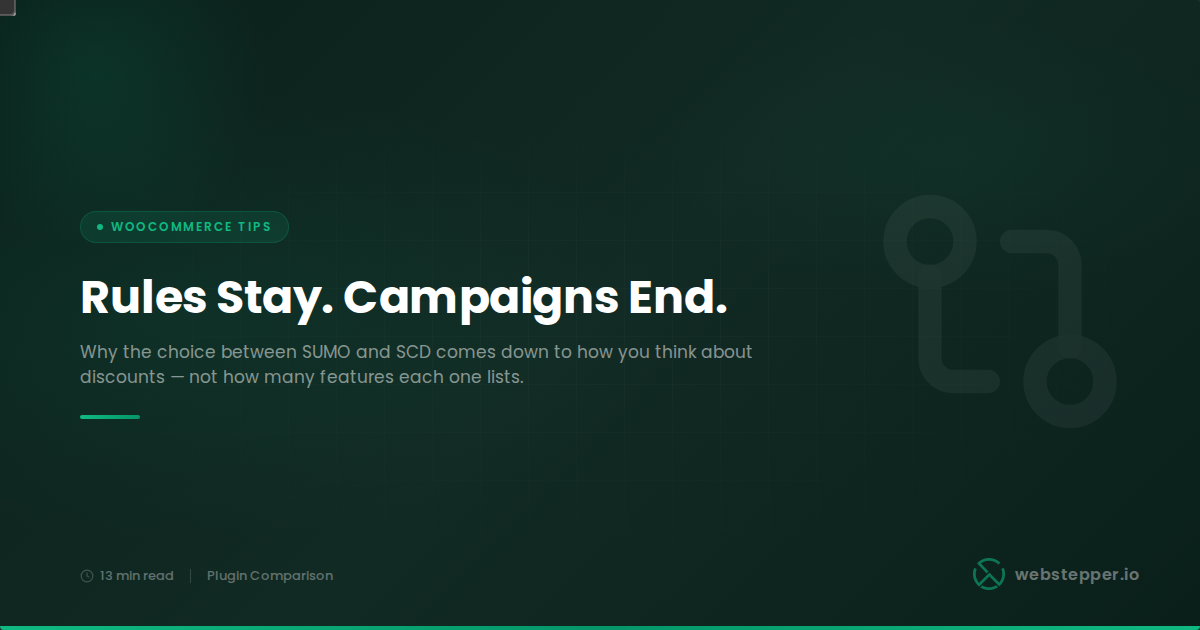
The core design difference: rules vs. campaigns
SUMO WooCommerce Dynamic Pricing Discounts is designed around discount rules. You create a rule — for example, “when a customer adds 5 or more of Product X, apply 15% off” — and that rule stays active indefinitely unless you manually disable it. Rules can be scoped by date range and day of week, but they don’t have a lifecycle beyond “on” and “off.” The mental model is a condition: if X, apply discount Y.
Smart Cycle Discounts is designed around campaigns. A campaign has a name, a start date, an end date, a discount type, and a product scope. It moves through states — draft, scheduled, active, expired — automatically, without you needing to remember to turn anything on or off. The mental model is a promotion: this sale runs from Tuesday to Sunday, then it ends and you can see it in history.
This distinction sounds abstract until you’ve managed a store through a busy promotional calendar. With a rules-based system, your job is remembering which rules are live and whether they’re still relevant. With a campaign system, the calendar is built in — promotions have a clear beginning, middle, and end, and the interface reflects that.
Neither design is universally better. If you run standing discounts that rarely change — a permanent volume pricing table for wholesale customers, for example — a rules-based system is perfectly adequate. If you run time-limited events (flash sales, Black Friday, seasonal deals, recurring weekend specials), a campaign lifecycle saves real operational overhead.
Side-by-side feature comparison
The table below reflects verified features as of June 2026. SUMO data is drawn from the CodeCanyon listing (v7.0.0) and FantasticPlugins vendor page. SCD data is from the plugin’s readme.txt (v2.1.2) and code.
| Feature | SUMO Dynamic Pricing | Smart Cycle Discounts |
|---|---|---|
| Pricing model | Paid only — $39 one-time (CodeCanyon) | Freemium — free on WordPress.org; Pro from $59/yr |
| Free version available | No | Yes |
| Percentage off | Yes | Yes (free) |
| Fixed amount off | Yes | Yes (free) |
| BOGO / Special offer discounts | Yes | Yes (free) |
| Tiered / volume pricing | Yes | Pro only |
| Cart total / spend threshold discounts | Yes | Pro only |
| Bundle discounts | Not confirmed | Pro only |
| User role targeting | Yes | Yes (free) |
| Location / country targeting | Not confirmed | Yes (free) |
| Scheduled start/end dates | Yes (date ranges) | Yes (date + time) |
| Time-of-day scheduling | Based on available docs — limited evidence | Yes (minute-level) |
| Day-of-week restrictions | Yes | Handled via recurring campaign windows |
| Recurring / repeating promotions | No | Yes (free) — continuous or instances mode |
| Campaign lifecycle (draft → active → expired) | No — rules are on/off only | Yes |
| Campaign health / conflict detection | Rule priority ordering | Yes — pre-launch intelligence warnings |
| Promo code / coupon code delivery | Not confirmed | Yes (free) — any discount type can require a code; URL auto-apply included |
| Bulk unique code generation | Not confirmed | Pro only (up to 50,000 codes/campaign) |
| Sale badge / strikethrough on product pages | Yes — “On Sale” tag shown on discounted products | Yes — through WooCommerce’s price filters |
| Quantity pricing table on product page | Yes | Handled via Promotional Visuals (free for tier ladders in basic form; Pro panels) |
| AI campaign drafting | No | Yes (free: 10 drafts/month; Pro: 50/day) |
| Analytics dashboard | Not confirmed in reviewed sources | Pro only (full dashboard); basic Campaign Intelligence in free |
| SUMO ecosystem integrations | Yes — Memberships, Reward Points, Subscriptions | Not applicable |
| HPOS compatible | Yes (since v6.1.0) | Yes |
On “not confirmed” cells
Several SUMO cells are marked “not confirmed.” This means the feature wasn’t documented in the sources we reviewed — the CodeCanyon listing, FantasticPlugins vendor page, and available third-party documentation as of June 2026. “Not confirmed” does not mean the feature is absent; it means we couldn’t verify it to the standard required for a comparison post. Check the official SUMO documentation before treating these as definitive gaps.
Where SUMO genuinely wins
Being accurate about a competitor means acknowledging where they’re ahead. SUMO has real advantages in several areas.
Tiered pricing and cart discounts included in the single purchase price
SUMO WooCommerce Dynamic Pricing Discounts includes tiered/volume pricing and cart total threshold discounts at the base $39 price. In Smart Cycle Discounts, both of these require the Pro upgrade. If tiered pricing and spend thresholds are your primary use case and you have no need for recurring campaigns or advanced scheduling, SUMO’s one-time payment gives you more out of the box for less money upfront.
For a store that wants “buy 5 get 10% off, buy 10 get 20% off” on a permanent product — not a time-limited promotion — SUMO’s pricing position is genuinely better for that specific need.
SUMO ecosystem integrations
If you’re already running SUMO Memberships, SUMO Reward Points, or SUMO Subscriptions, the discount plugin integrates with those systems in ways that Smart Cycle Discounts doesn’t. Membership-tier discounts and reward-points-based pricing require investment in the broader SUMO stack, but for stores that are already there, this is a meaningful advantage. The ecosystem coherence is real.
Day-of-week restrictions as a native feature
SUMO includes day-of-week restrictions directly in the rule interface. Smart Cycle Discounts handles repeating day-of-week promotions through recurring campaigns, which is a different interaction model. If you want a standing “Tuesday discount” that never changes and you think of it as a rule condition rather than a campaign event, SUMO’s approach is more direct.
One-time payment
CodeCanyon plugins use a one-time licensing model. You pay $39, you own the plugin. You can continue using it indefinitely even after support expires. For a store on a tight budget that doesn’t need the specific features in SCD’s Pro tier, this is a genuine financial advantage over an annual subscription model.
CodeCanyon support model
CodeCanyon’s standard license includes six months of author support from FantasticPlugins. After that, you continue using the plugin but aren’t entitled to new support tickets without purchasing an extended support package. This is normal for CodeCanyon items. Updates are typically included for the life of the product regardless of support tier.
Where Smart Cycle Discounts genuinely wins
Smart Cycle Discounts is the plugin we make. The areas where it leads are the ones we’ve specifically invested in — so it would be suspicious if there were no differences. Here’s where the gap is real.
Campaign lifecycle and scheduling precision
Smart Cycle Discounts tracks every promotion through a full lifecycle: draft, scheduled, active, expired. Campaigns activate and deactivate automatically at a specific date and time (minute-level precision), without any manual toggling. When a campaign ends, your product prices revert cleanly. You don’t have to remember to turn anything off.
SUMO’s discount rules use date-range scoping, which provides start and end dates. The main practical difference is that SUMO’s rules are stateless — once the date passes, the rule is simply inactive, but there’s no history view of “these promotions ran last quarter.” SCD keeps that history, which matters for seasonal planning (“what did I run for Black Friday last year?”).
For stores running event-driven promotions — flash sales, holiday events, launch-day specials — SCD’s scheduling model means fewer manual interventions and less risk of forgetting to end a discount.
Recurring campaigns as a first-class feature
Smart Cycle Discounts includes recurring campaigns in the free version. You create a “Weekend Sale” once, tell it to repeat every Saturday and Sunday, and it runs automatically without any further action. Two modes are available: continuous mode (toggles the campaign on/off by time window, ideal for recurring deals-of-the-week) and instances mode (creates a distinct campaign record for each occurrence, useful for per-event analytics).
SUMO has no equivalent recurring automation. Day-of-week restrictions let you say “this rule only fires on Saturdays,” but you still need to manually configure a new promotion if you want the same deal to run on a schedule with defined start and end times that repeat. It’s a meaningful workflow difference for stores running regular promotional events.
Campaign conflict detection before launch
Smart Cycle Discounts runs a pre-launch intelligence check on every campaign before it goes live. If two campaigns target the same product with different discounts, the system surfaces the conflict and the priority relationship before customers see it. SUMO handles conflicts through a priority ordering system on rules, which is workable but passive — it resolves conflicts when they occur rather than warning you about them before launch.
The difference matters at scale: if you’re running six active promotions across overlapping product sets, SCD’s proactive conflict warnings reduce the chance of an unexpected combined discount reaching a customer.
A genuine free version
SUMO WooCommerce Dynamic Pricing Discounts has no free version. You pay $39 to install and test it on a live store. Smart Cycle Discounts is free on WordPress.org and includes percentage discounts, fixed amount discounts, BOGO, recurring campaigns, user role targeting, location targeting, scheduling with time precision, and coupon code delivery — all without a license key. The Pro tier adds tiered pricing, spend thresholds, bundle discounts, advanced analytics, and bulk code generation.
For a store that’s evaluating options and wants to test something properly before paying, this is a meaningful practical difference. The full breakdown of what SCD’s free and Pro tiers include is covered separately if you want to map features to your specific needs before making a decision.
Promo code / coupon code delivery on any discount type
Smart Cycle Discounts added code-gated campaigns in version 2.1.0. Any campaign — including BOGO, tiered, and bundle promotions — can be configured to require a promo code at checkout rather than auto-applying. The code integrates with WooCommerce’s native coupon field so the experience is familiar to customers. URL auto-apply (?wsscd_code=YOURCODE) works for sharing codes in emails and social posts. This feature isn’t confirmed in SUMO’s current documentation.
For stores that run influencer codes, email-blast promos, or VIP-only deals that still need the BOGO or tiered structure, code-gated campaigns on non-percentage discount types close a gap that most pricing plugins leave open. The broader mechanics of how code-gated and auto-apply promotions differ is covered in the post on when to use a code-gated discount vs. an auto-apply campaign.
How the pricing models compare
Pricing comparison requires being specific about what you get at each price point.
SUMO WooCommerce Dynamic Pricing Discounts costs $39 for a regular license on CodeCanyon (at the time of writing). This is a one-time payment. You get the full plugin, including tiered pricing, cart discounts, BOGO, user role discounts, and day-of-week scheduling. Six months of support from FantasticPlugins is included; you can extend it. No recurring charge unless you extend support.
Smart Cycle Discounts has a free version on WordPress.org that includes percentage discounts, fixed amount discounts, BOGO, scheduling, recurring campaigns, user role and location targeting, and promo code delivery. The Pro tier starts at $59/year for a single site and adds tiered pricing, spend thresholds, bundle discounts, advanced analytics with CSV/JSON export, bulk unique code generation (up to 50,000 codes per campaign), and advanced subscription discount controls.
For a store that specifically needs tiered pricing and cart discounts without any of the campaign management features, SUMO’s $39 one-time payment is less than SCD Pro’s first year. For a store that needs tiered pricing plus recurring campaigns, conflict detection, promo code delivery, and the analytics dashboard, SCD Pro adds features SUMO doesn’t cover.
The honest framing: if your primary use case is permanent volume pricing rules for a B2B store, SUMO is the better value. If your primary use case is running a promotional calendar with time-limited events, SCD is worth the annual cost because those automation features save real time over a year of operations.
Real workflow differences you will feel day-to-day
The feature table captures what each plugin can do. This section is about what it feels like to use them over a month of actual store operations.
Setting up a flash sale
With SUMO, you create a discount rule, set a date range covering your flash sale window, and save it. When the sale ends, the rule’s date range expires. Simple. The limitation is that you need to manually verify the rule is no longer active after the end date, and there’s no dashboard showing you “active right now vs. upcoming vs. recently expired.”
With SCD, you create a campaign, set the start and end datetime, and schedule it. The campaign moves through states automatically and appears in your history when it expires. If you want to run the same flash sale again next month, you duplicate the campaign and update the dates rather than reconfiguring from scratch.
Managing a promotional calendar with multiple concurrent deals
If you’re running a sitewide percentage off, a volume pricing structure for wholesale customers, and a BOGO on a specific product category — all simultaneously — you need to know what’s active and whether any of those rules are stepping on each other.
SUMO relies on its rule priority ordering to resolve conflicts. You set priorities manually and trust the system to apply the right one. There’s no pre-launch check telling you that your new BOGO campaign will conflict with the existing volume rule on Product X.
SCD’s Campaign Intelligence runs that check for you before you publish. You see which campaigns overlap and what the priority resolution is before a customer experiences it. For stores with a complex simultaneous promotion setup, this proactive visibility is worth more than it might sound on paper. The post on how WooCommerce discount plugins handle overlap and conflict covers this design pattern across multiple plugins.
Recurring weekend promotions
Both plugins handle the concept of a weekend-only discount, but through different mechanisms. SUMO lets you add day-of-week restrictions to a rule so it only fires on specific days. SCD lets you create a recurring campaign that activates on a defined schedule and repeats indefinitely. The difference is whether you think of this as “a rule that has a weekend-only condition” or “a campaign that recurs every weekend.” For most store owners, both work fine; the mental model preference varies.
Who should pick which
After going through the details, the decision narrows to a few clear scenarios:
| Your situation | Better fit |
|---|---|
| You need tiered/volume pricing and cart threshold discounts and your budget is limited | SUMO Dynamic Pricing — includes both at $39 one-time |
| You’re already using SUMO Memberships, Reward Points, or Subscriptions | SUMO Dynamic Pricing — ecosystem integrations add genuine value |
| You run standing discounts for wholesale/B2B customers that rarely change | SUMO Dynamic Pricing — a rule-based system fits this model naturally |
| You want to try a discount plugin before paying | Smart Cycle Discounts — full-featured free version on WordPress.org |
| You run seasonal sales, flash sales, or promotional events on a calendar | Smart Cycle Discounts — campaign lifecycle, scheduling to the minute, expiry automation |
| You need recurring promotions that repeat automatically (weekly specials, etc.) | Smart Cycle Discounts — recurring campaigns in the free version, SUMO has no equivalent |
| You want pre-launch warnings when campaigns conflict | Smart Cycle Discounts — Campaign Intelligence flags conflicts before they reach customers |
| You need code-gated BOGO or tiered promotions | Smart Cycle Discounts — promo code delivery works on every discount type |
| You need location/country-based discount targeting | Smart Cycle Discounts — billing or shipping country targeting in the free version |
Common questions answered directly
Is SUMO Discount Manager the same as SUMO WooCommerce Dynamic Pricing Discounts?
Yes. “SUMO Discount Manager” is an informal name that many store owners use when searching — the official plugin name is SUMO WooCommerce Dynamic Pricing Discounts, published by FantasticPlugins on CodeCanyon (item 17116628). It is not the same as other “SUMO” plugins in the FantasticPlugins catalog (Subscriptions, Memberships, Reward Points, etc.), though it integrates with those when they’re installed.
Does SUMO Dynamic Pricing show sale badges on product pages?
Yes. SUMO applies an “On Sale” tag to discounted products and shows the discounted price on product pages. A quantity pricing table can also be displayed on product pages to communicate volume discount tiers to customers browsing individual products. This is one of SUMO’s user experience strengths for tiered pricing visibility.
Does Smart Cycle Discounts show sale badges too?
Yes. Smart Cycle Discounts applies discounts through WooCommerce’s price filters, which means your theme’s existing “Sale!” badge and strikethrough pricing display automatically on shop pages, category pages, product pages, and search results — without any additional configuration. One thing to know: because discounts are applied at display time rather than written to the stored _sale_price field, products discounted by SCD won’t appear in WooCommerce’s native “On Sale” shortcode/block or third-party sale filters that read stored sale data (FacetWP, etc.). SUMO shares this same architectural characteristic for its runtime-applied discounts.
Can I run SUMO Dynamic Pricing alongside WooCommerce coupons?
Yes. SUMO includes a setting to allow or prevent stacking with products that already have a sale price, and the documentation indicates you can configure how rules interact with existing promotions. Standard WooCommerce coupons operate at the cart level separately from SUMO’s product and quantity pricing rules. Test your specific configuration before going live.
Which plugin is better for a store just getting started with discounts?
Smart Cycle Discounts is easier to evaluate because it has a free version. You can install it, run a real campaign, and experience the interface without paying anything. SUMO requires a $39 purchase before you can test it meaningfully on your own store. If you know you need tiered pricing and you’ve already decided to pay for something, SUMO’s entry price is lower than SCD Pro. If you’re still evaluating, starting with SCD’s free version costs nothing and gives you a real sense of how campaign-based discounting works in practice.
Does SUMO Dynamic Pricing support recurring or repeating promotions?
Not as a dedicated feature based on current documentation. SUMO’s day-of-week restrictions allow rules to fire only on specific days of the week, which partially covers the use case of recurring promotions. But there’s no equivalent to SCD’s recurring campaign system, where a single configuration creates a promotion that automatically activates and deactivates on a repeating schedule (every weekend, every Monday, monthly, etc.).
What happens to my discounts if I switch plugins?
Both plugins apply discounts at runtime — neither writes permanent price changes to the database. Deactivating either plugin returns your products to their original prices without cleanup work. Smart Cycle Discounts explicitly removes all plugin data on full deletion. Always verify your product prices look correct after any plugin change.
Closing reflection
SUMO WooCommerce Dynamic Pricing Discounts is a legitimate choice. It’s been actively maintained for years, covers the essential discount types, works well for permanent pricing rules, and carries an honest price for what it delivers. If you’re building a standing pricing structure — wholesale tiers, role-based rates, volume tables that never expire — it does that job cleanly.
Smart Cycle Discounts was built with a different problem in mind: the store that runs promotions as events, not just as conditions. Flash sales, seasonal campaigns, recurring weekend deals, BOGO promotions that need to end at midnight on Sunday — the campaign lifecycle approach keeps that kind of store organized without manual babysitting.
The question worth sitting with: does your discount strategy look like a set of rules that stay constant, or like a calendar of events that come and go? That’s not a technical question. It’s a question about how you think about your own promotions. The plugin that matches your mental model will feel natural. The one that doesn’t will feel like friction every time you use it.
If you want to compare SUMO to the broader field, the full WooCommerce discount plugin comparison covers Flycart, YITH, RightPress, and SCD side by side. If you’re specifically weighing up tiered pricing options, the post on tiered pricing vs. quantity discounts in WooCommerce is worth reading before you decide.
Key Takeaways
- SUMO WooCommerce Dynamic Pricing Discounts is a paid-only plugin ($39 one-time on CodeCanyon, v7.0.0 as of March 2026). Smart Cycle Discounts is freemium with a meaningful free tier on WordPress.org.
- SUMO includes tiered pricing and cart threshold discounts at the base price — a genuine advantage if those are your primary needs and you don’t need recurring campaigns or campaign lifecycle management.
- Smart Cycle Discounts has no equivalent to SUMO’s ecosystem integrations with SUMO Memberships, Reward Points, and Subscriptions. If you’re already in that stack, that matters.
- SCD’s recurring campaigns, pre-launch conflict detection, and campaign lifecycle (draft → scheduled → active → expired) have no equivalent in SUMO’s current feature set.
- Both plugins show sale badges and discounted prices on product pages. Neither writes to the stored WooCommerce sale price field, so neither appears in the “On Sale” shortcode or third-party stored-sale filters.
- The core choice: if your discounts are permanent or near-permanent rules, SUMO fits naturally. If your discounts are time-limited events on a promotional calendar, SCD’s campaign model saves real operational overhead over time.
Try Smart Cycle Discounts free
Percentage off, fixed amount, BOGO, recurring campaigns, role targeting, and minute-level scheduling — all in the free version. No license key required to get started.