WooCommerce Customer Groups vs Roles vs Segments: What Is the Difference?

Customer Architecture · Practical Comparison
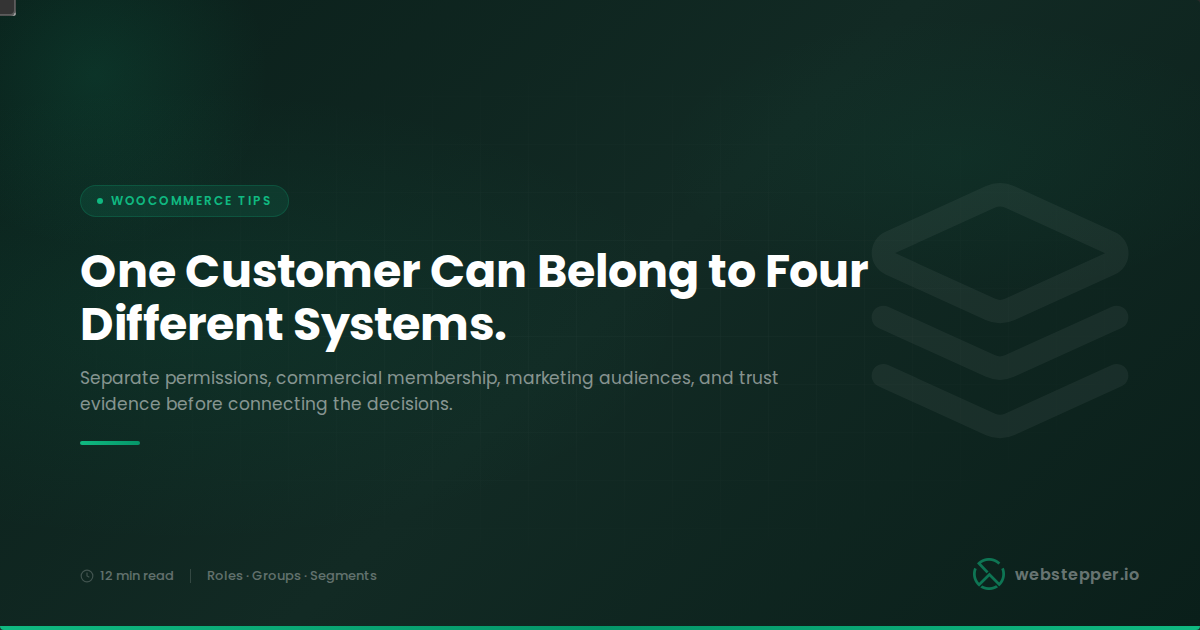
WooCommerce Customer Groups vs Roles vs Segments: What Is the Difference?
A wholesale buyer, a dormant customer, and a high-risk customer can be the same person. The labels sound similar, but they answer different business questions.
WooCommerce does not give the words group, role, and segment
Treating those labels as interchangeable creates brittle stores. A marketing rule becomes an access-control rule, a temporary risk signal becomes a permanent account label, or a customer stops receiving the correct price because a plugin expected a role that another system never assigned.
The right question is not “Which label should I use?” It is “What decision must this label control, and how quickly should it change?”
The short answer
| Structure | Best used for | Usually changes | Poor fit |
|---|---|---|---|
| WordPress role | Permissions, access, stable pricing eligibility | Rarely | Fast-changing behavior |
| Customer group | Business-defined membership or commercial tier | Occasionally | Universal access control unless mapped to capabilities |
| Marketing segment | Campaign audiences based on recency, value, products, or engagement | Frequently | Security decisions |
| Trust segment | Review priority and fraud-risk response | As evidence changes | Rewarding spend without considering risk |
These structures are not competitors. A mature store often uses all four, but it keeps their responsibilities separate.
WordPress user roles: durable permissions and eligibility
Every registered WooCommerce customer is a WordPress user. WordPress roles collect capabilities—permissions such as reading content or managing orders. WooCommerce adds roles including Customer and Shop Manager. Other plugins can register roles such as Wholesale Customer or Trade Buyer.
A role is useful when the rule should remain stable across sessions: who may see a private catalog, who receives wholesale pricing, or who can administer orders. Smart Cycle Discounts can include or exclude selected user roles when targeting a campaign, so a promotion can apply to Wholesale Customer while remaining invisible to retail buyers.
A role is not a score. WordPress does not automatically promote a profitable customer to VIP or demote a serial refunder. A role changes only when your code, an administrator, or another plugin changes it.
Guest customers also have no persistent WordPress account role. If guest checkout is important, do not build your complete customer strategy around roles alone.
Customer groups: a business label whose mechanics depend on the plugin
“Customer group” is a product-level concept rather than a single WooCommerce core object. One extension may store a group as a custom user role. Another may attach user metadata. A B2B suite may maintain its own role-like record with pricing rules, approval state, credit limits, and tax settings.
That flexibility is useful, but integrations cannot assume two group systems mean the same thing. Before connecting a discount, reporting, or email tool, identify where group membership is stored and whether it is synchronized to a WordPress role.
- Use a group for a contractual or operational relationship such as distributor, employee, dealer, or approved wholesale buyer.
- Do not use a group as a substitute for a live query like “ordered in the last 30 days.”
- Document the source of truth. If both a B2B plugin and an ERP can modify membership, decide which one wins.
Marketing segments: dynamic answers to customer questions
A segment is normally the result of rules applied to customer data. “Three or more orders,” “last purchase over 90 days ago,” “bought category A,” and “lifetime spend above $500” are segment conditions. Because the underlying facts change, membership should be recalculated rather than manually maintained.
Marketing segments are excellent for win-back campaigns, product recommendations, lifecycle messages, and measuring retention. They are not sufficient fraud controls. High spend may make someone commercially valuable while repeated refund or dispute behavior makes the next order operationally risky.
The guide to WooCommerce customer behavior analytics explains how order frequency, coupon use, returns, and disputes answer different questions. For discount audience design, see how to segment customers for discounts.
TrustLens segments: dynamic risk context, not marketing personas
TrustLens calculates a 0–100 trust score from store behavior and places customers into six explainable segments: VIP, Trusted, Normal, Caution, Risk, and Critical. The profile shows the signals that moved the score, so a reviewer can distinguish a long successful history from refund abuse, coupon patterns, disputes, linked accounts, or other risk evidence.
This classification is intentionally different from a WordPress role. A customer can remain a Wholesale Customer while their trust segment moves from Trusted to Caution after new evidence. You preserve the commercial relationship and change the review posture instead of rewriting access architecture every time risk changes.
TrustLens Free does not automatically block customers merely because they enter Risk or Critical. It gives the merchant evidence and manual control. Pro automation can connect defined triggers to actions when a store deliberately chooses that policy.
A clean architecture that lets all four work together
- Use roles for durable access. Keep wholesale, member, employee, and administrative eligibility stable and auditable.
- Use groups for commercial relationships. Let the owning B2B or membership system manage its richer business record.
- Use marketing segments for audiences. Recalculate recency, frequency, monetary value, product affinity, and engagement.
- Use trust segments for review posture. Let behavioral evidence decide how much scrutiny an order deserves.
- Join decisions at the campaign or workflow layer. For example: offer a role-targeted SCD campaign to approved wholesale buyers, but manually review a new order when the same buyer’s trust evidence has deteriorated.
Avoid automatic label copying without expiry. Turning “Risk” into a permanent WordPress role or copying “Dormant” into a never-cleared user tag freezes a temporary conclusion into account architecture.
Three practical examples
Wholesale pricing
The user role or B2B group establishes eligibility. Smart Cycle Discounts targets the appropriate role. A marketing segment may identify inactive wholesale accounts for outreach. TrustLens independently informs review of the resulting order.
VIP rewards
A spend-based marketing segment finds valuable buyers. TrustLens can show whether their behavior is also consistently trustworthy. Rewarding someone because they spend heavily without checking refund and dispute history can turn “VIP” into “expensive abuse.”
Guest checkout
A guest has no durable account role. Email and order history may still support marketing analysis, while TrustLens can use available local evidence to support risk review. Your workflow needs graceful fallbacks rather than assuming a user ID exists.
Frequently asked questions
Is a WooCommerce customer group the same as a WordPress role?
Sometimes a plugin implements groups as roles, but not always. Inspect the plugin’s data model and integration documentation before relying on role-based pricing or access.
Can one customer belong to several segments?
Yes. A customer can be high-value, dormant, interested in one category, and in a Caution trust segment at the same time. Those labels describe different dimensions.
Should TrustLens change customer roles automatically?
Usually no. Roles control durable access, while trust is dynamic. Keep the systems separate and connect them through explicit, reversible workflows where necessary.
Target the offer. Understand the risk.
Use Smart Cycle Discounts for role-targeted campaigns and TrustLens for explainable customer trust—without forcing two different decisions into one label.
Key takeaways
- Roles control durable permissions and eligibility.
- Groups model business membership, but their implementation varies by plugin.
- Marketing segments answer dynamic audience questions.
- Trust segments organize changing risk evidence.
- Keep each system as a separate source of truth and combine them only at explicit decision points.